Nearly nine in ten UK councils now collect food and beverage cartons at the kerbside — so it came as a jolt this month when news broke that the UK has effectively stopped processing them. It’s one of the clearest examples of a problem quietly undermining the circular economy: the gap between what we collect and what we actually recycle. A material is only recycled if it can be reliably separated, baled to specification, and sold to a reprocessor. When sorting breaks down, otherwise recyclable material slides into residual waste — and every kerbside promise to the public goes unmet. That is why optical sorting for cartons is the answer to a problem the UK faces right now. Cartons sit right at the heart of this problem , and they show exactly why sorting, not collection, is the real bottleneck.
Why optical sorting for cartons is difficult?
A drinks carton looks simple, but it’s one of the most complex items on a sorting line — a laminate of paperboard, polymer and a thin layer of aluminium, designed to keep food fresh but awkward to identify at speed. Near-infrared (NIR) sorters read the surface they see first, so a carton can be misread as paper or plastic depending on how it lands. Manual pickers can spot them, but not reliably at the throughput a modern MRF demands. The result: cartons in the wrong bale, contaminating other streams, or lost to residual altogether.
What AI-powered optical sorting for cartons changes — and where it’s already running
Recycleye’s technology approaches the problem the way a person does — by looking. Our computer-vision system, trained on millions of real waste images, recognises items by appearance and shape, not just surface chemistry, so it can identify a carton as a carton even in a busy dry mixed recyclables stream where NIR alone would be fooled.
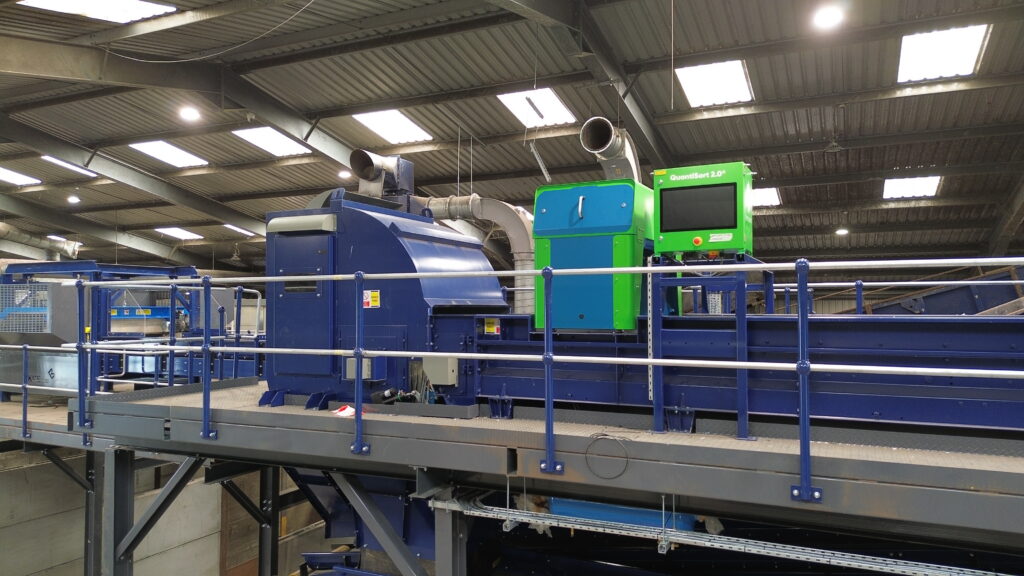
This isn’t theoretical. We already have two Recycleye QuantiSort® AI optical sorters installed and operating in the UK, each dedicated specifically to carton recovery — pulling the drinks cartons that legacy sorting finds hardest cleanly out of the stream and producing the better-specified bale reprocessors can actually take. The same vision layer also powers Recycleye QualiBot®, our robotic picking arm, and because every item is detected and logged, operators get live visibility of exactly what’s flowing through their plant.

Located in the North of England , this facility uses Recycleyes AI-powered optical sorting technology to identify and separate cartons more accurately and efficiently than traditional sorting methods, helping to maximise recycling performance.
Sorting is the circular economy’s real bottleneck
Waste is increasingly collected but not recovered, because the accuracy and economics of sorting haven’t kept pace with ambition. The circular economy doesn’t fail at the kerbside — it fails on the sorting line. Optical sorting for cartons changes that maths: by recognising complex materials the way a person would and acting at machine speed, it makes difficult streams viable to recover. Two QuantiSort® units already dedicated to carton sorting are proof that the technology to close the gap exists, works, and is running today.
Want to be a part of our solution ?