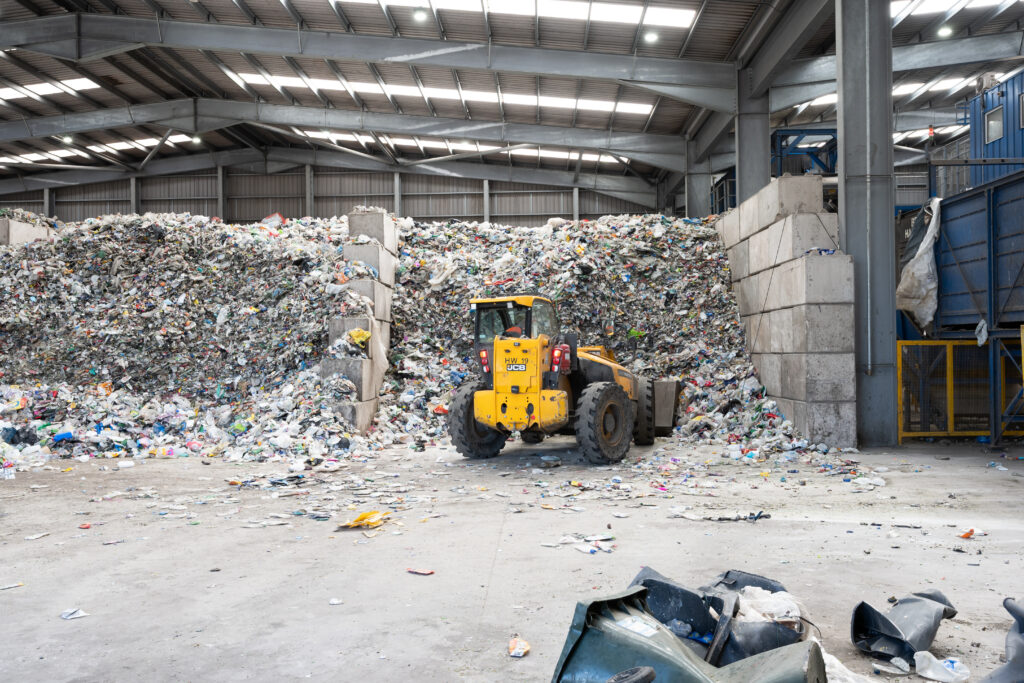
Dry mixed recyclables (DMR) volumes are climbing — and for many materials recovery facilities, sorting capacity is the new bottleneck. A MRF’s optical sorters should move with the times to meet this demand. The UK’s Simpler Recycling reforms now require workplaces to separate recyclables from general waste, pushing a substantial new and complex stream of commercial DMR into a system that household collections were already filling.
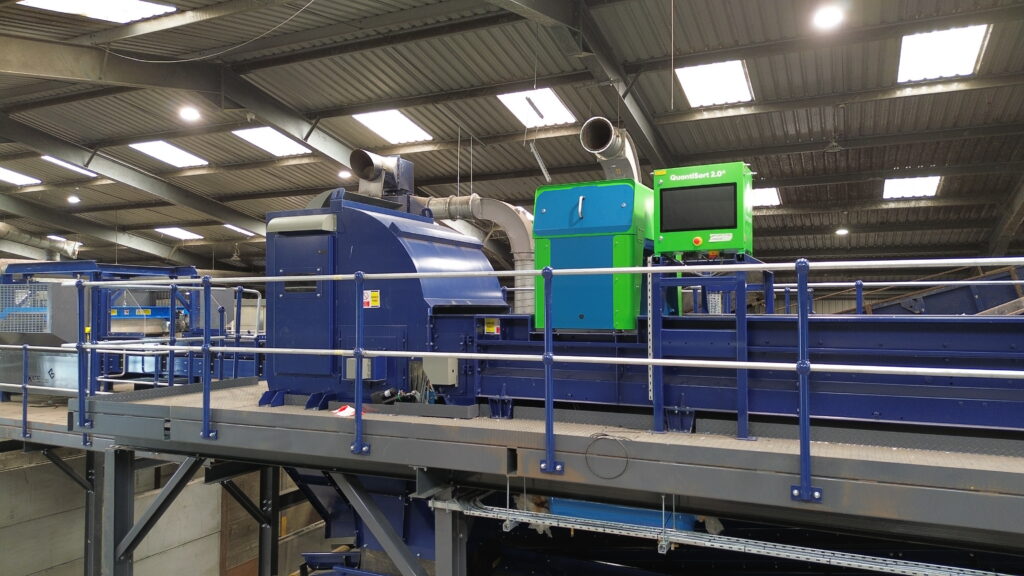
More material should be good news for recyclers. But DMR is only as valuable as the optical sorters behind it: mixed streams of paper, card, plastics and metals arrive in unpredictable compositions, and every percentage point of contamination or missed capture eats directly into bale quality and revenue. QuantiSort 2.0®, Recycleye’s AI-powered high-speed sorter, was designed for exactly this problem.
Why DMR streams are growing — and getting harder
Three pressures are converging on MRFs at once.
Regulation is expanding the stream. Simpler Recycling is bringing workplaces into mandatory separate recycling collections and standardising what households put out, while Extended Producer Responsibility for packaging raises the commercial stakes on every tonne that flows through.
Composition is shifting. Commercial DMR looks different from household DMR — typically more card and film, different plastic profiles — so facilities tuned for kerbside material now face infeed they weren’t configured for, and it changes week to week.
Labour remains scarce. Manual picking lines were hard to staff before volumes rose. Asking the same headcount to process more tonnes at the same quality level isn’t a strategy — it’s a hope.
What QuantiSort 2.0® does differently
QuantiSort 2.0® is the result of 7+ years of research and development, powered by AI trained on billions of waste images. Its computer vision system, CogniScan®, identifies every item on the belt by its visual features — not just its material signature — enabling distinctions that conventional optical sorters can’t make.
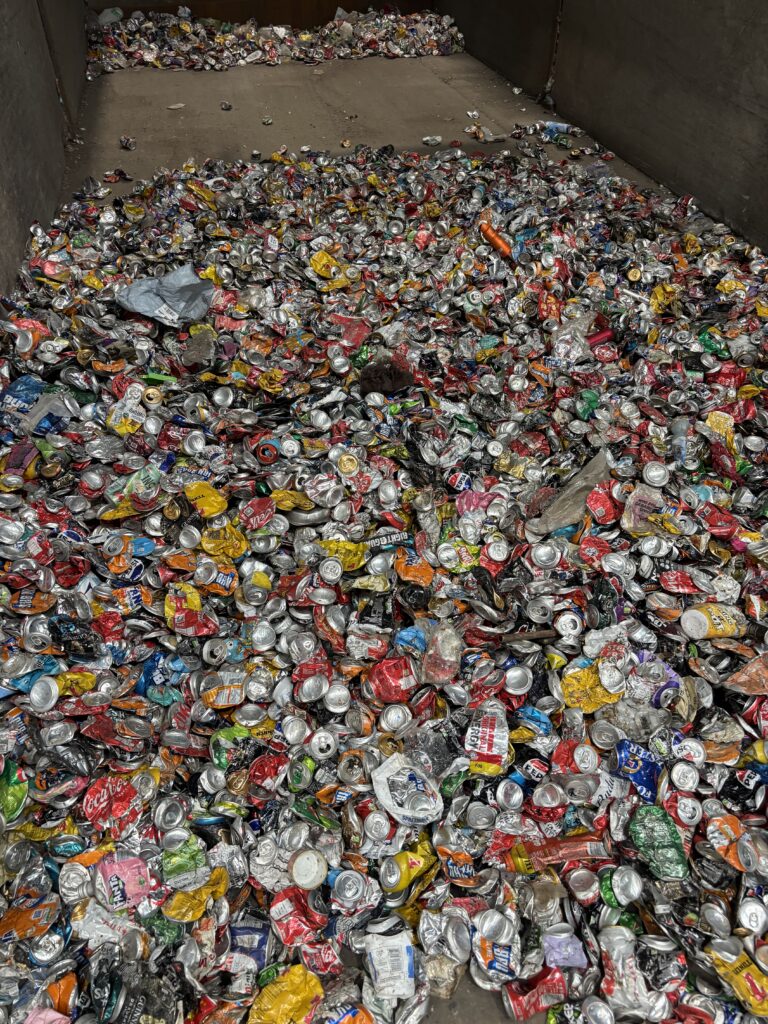
For DMR streams, that granularity is the difference between a commodity bale and a premium one. QuantiSort 2.0® sorts and detects:
- Food-grade PET vs. non-food-grade PET — critical as demand for food-contact rPET outstrips supply
- Aluminium foil vs. aluminium aerosol — separating high-value fractions and removing hazards in one pass
- LDPE film vs. LLDPE film — polymer-level film sorting that most facilities currently can’t achieve at speed
And it does this at bulk-sorting pace: up to 1,000 ejections per minute on belt speeds up to 4.5 m/s, in a binary sort configuration that slots into existing lines (available in 1,200 mm, 2,000 mm and 2,800 mm working widths).
Precision ejection, not just precision detection
Identifying an item correctly only pays off if you eject it cleanly. QuantiSort 2.0®’s ejection system pairs VBPS with Recycleye’s SpiralShield® valve technology: nozzles positioned close to the end of the acceleration belt for minimal collateral ejection, stronger ejection force with lower air consumption, and two features that matter enormously on variable DMR infeed — adaptive eject size, which adjusts the ejection pattern based on surrounding objects, and ejection suppression, which lets operators choose whether to prioritise purity or recovery when the risk of collateral pickup is high. As offtaker specs tighten under EPR, that purity/recovery dial is a commercial lever, not just a technical one.
One machine, many recipes
DMR composition will keep shifting as Simpler Recycling phases in. QuantiSort 2.0® is built for that: the same hardware runs multiple sorts — operators simply change the recipe from the control panel. When the commercial fraction of your infeed grows or a new target material becomes valuable, you reconfigure software, not steelwork.
See what’s in your stream
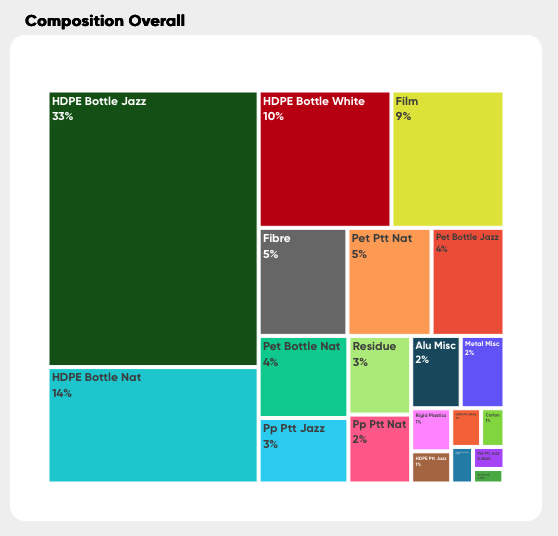
Every item QuantiSort 2.0® scans becomes a data point. Recycleye’s online dashboard gives operators continuous compositional analysis of the line, unit performance monitoring and plant running time — filterable by minute, hour, week or custom range, exportable to Excel or CSV, and accessible anywhere. When the DMR stream shifts, you know within hours, not at the next manual sampling audit. Under EPR, that auditable, item-level composition record is increasingly valuable.
QuantiSort 2.0® builds on more than 55 Recycleye systems deployed worldwide, including our fleet of already established optical sorters and QualiBot®, with the sensing module engineered for real MRF conditions — resilient to dust, moisture, chevrons and ambient light changes, backed by Recycleye Care’s proactive remote monitoring and preventative maintenance. Operators including Cumbria Waste Management and Levenseat trust Recycleye’s AI sorting on high-volume streams.
Getting ready for the next wave
The DMR increase isn’t a spike: these volumes are changing for good. Facilities that treat today’s volumes as the new baseline — and build sorting granularity, quality assurance and composition visibility to match — will be the ones winning the material and the off take contracts that follow.If your facility is seeing DMR volumes rise, we’d be glad to show you what QuantiSort 2.0® could recover from your stream.
Get in touch with our team to book a demo on your stream today.